Best AI Christmas Photo Prompts That Keep Likeness
Updated 2026-09-16 · PiXmas Editorial Team
Quick answer: The best AI Christmas photo prompts keep likeness by describing the scene, lighting, and clothing while leaving the face untouched, so the model edits the background and outfit instead of reconstructing features. Apps built for portraits, like PiXmas, use guided prompt templates and multiple reference angles from one phone photo to lock in facial structure across 800+ Christmas styles.
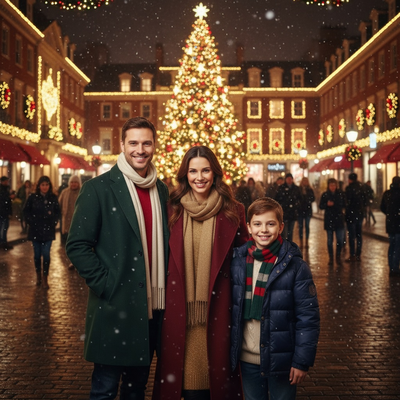
What makes an AI Christmas prompt keep likeness?
A likeness-safe prompt separates two things: what changes and what must not change.
Good prompts describe the Christmas scene, outfit, and lighting in detail, then explicitly instruct the model to preserve the person's face, skin tone, and proportions.
Weak prompts describe the whole image including the face, which invites the model to redraw features from scratch and drift away from the real person.
What is the structure of a likeness-safe prompt?
Effective Christmas photo prompts follow a repeatable order.
- State the subject and pose in plain terms, such as a person smiling by a decorated tree.
- Describe the Christmas setting: snow, fireplace, string lights, or a Santa scene.
- Specify clothing and accessories, like a red sweater or a Santa hat.
- Add a likeness instruction: keep the same face, same eyes, same skin tone as the reference photo.
- Set the style and lighting, such as warm cinematic light or a soft studio portrait look.
What example prompts work well for Christmas portraits?
Example one: a warm portrait near a decorated Christmas tree, soft golden lights, red and green wardrobe, keep the same face and expression as the reference photo, realistic skin texture.
Example two: a snowy outdoor scene at dusk, wearing a wool coat and scarf, string lights in the background, preserve facial features and proportions exactly, natural photo style.
Example three: a festive family-style portrait indoors, fireplace glow, matching pajamas, keep identity and likeness unchanged, only adjust clothing and background.
How do apps handle this differently than manual prompting?
Manual prompting in general image tools requires trial and error to phrase likeness instructions correctly.
Purpose-built apps remove that guesswork by pairing a fixed prompt template with a face-reference step, so the wording is already tuned for likeness retention.
PiXmas applies this approach across 800+ Christmas styles, using one uploaded phone photo as the reference for every portrait, Santa scene, and wallpaper it generates.
| Prompting approach | Likeness control | Effort required | Best for |
|---|---|---|---|
| Manual text prompt only | Low to moderate, depends on wording | High, needs testing | Users comfortable writing detailed prompts |
| Prompt plus one reference photo | Moderate to good | Medium | Casual single-image edits |
| Guided app template with face lock, like PiXmas | High, tuned specifically for faces | Low, mostly automated | Fast, consistent Christmas portraits from one photo |
What common mistakes break likeness?
Describing hair color, age, or facial shape in the prompt often causes the model to regenerate the face instead of preserving it.
Using extreme style words like cartoon, anime, or oil painting can also pull features away from the real photo, since those styles reinterpret faces heavily.
Uploading a blurry, angled, or poorly lit source photo weakens likeness no matter how careful the prompt wording is.
Limitations
No AI prompt guarantees a perfect match every time, since lighting shifts, heavy makeup styles, or extreme angles can still alter small details.
Group photos with several faces are harder to keep accurate than a single clear portrait.
Very stylized themes, like full costume transformations, naturally reduce likeness in exchange for a more dramatic look.
A likeness-safe Christmas photo prompt separates scene description from face description, and apps like PiXmas already build that structure in, turning one phone photo into consistent, recognizable results across 800+ styles.
Frequently asked questions
Why do some AI Christmas photos not look like me?
This usually happens when the prompt describes facial features directly, prompting the model to redraw the face instead of preserving it. Vague or low-quality source photos make this worse. Clear reference photos and prompts that avoid describing the face help likeness stay accurate.
Should I describe my face in the prompt?
No. Describing eyes, hair, or age in the prompt often causes the model to reinterpret those features instead of keeping the original ones. It works better to describe the scene and clothing, then instruct the tool to keep the face unchanged from the reference photo.
Can I get a good result from just one photo?
Yes, a single clear, well-lit, front-facing photo is usually enough. PiXmas is built around this exact workflow, turning one phone photo into a full set of Christmas portraits without needing multiple reference images.
What photo quality helps likeness the most?
A sharp, well-lit photo with a clear front-facing view of the face gives the best results. Avoid heavy shadows, extreme angles, or sunglasses, since these reduce how much facial detail the model has to work with.
Are more detailed prompts always better for likeness?
Not necessarily. Overly detailed prompts about the face can backfire by giving the model too much to reinterpret. Simpler prompts that focus on scene and style while explicitly preserving the face tend to keep likeness more consistent.